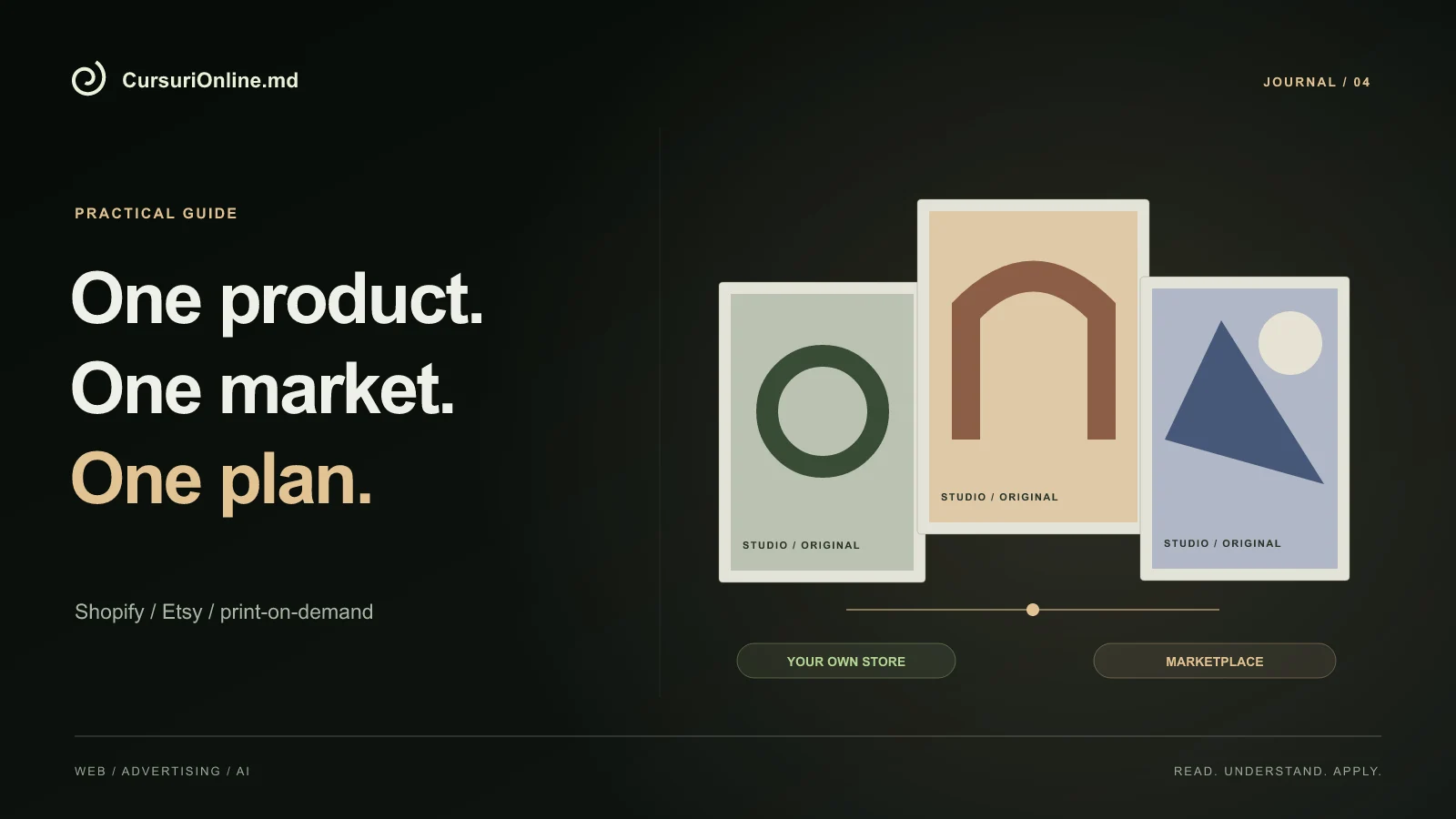
Shopify and Etsy come up frequently in discussions about selling online, but they solve different problems. A store of your own gives you a space that you organize for your brand. A marketplace has its own audience, its own rules and a specific way of presenting products. The choice should not be made only after a video promising a quick release.
This guide explains the relationship between product, platform, dropshipping and print-on-demand, with attention to the situation of a creator from Moldova. We use a demonstration example: a collection of original posters for offices and workspaces. You'll see what to check before you open a store, how to calculate an offer, and what you can practice in the direction of Shopify & Etsy.
Understand the difference between your own store and marketplace
In a Shopify store, you organize your brand presentation, collections, and purchase path within the confines of your chosen platform and configuration. You also need a strategy to bring in visitors. The existence of the website does not automatically create demand, and a published catalog without distribution can remain almost invisible.
Etsy is a marketplace with its own rules for eligible products and seller behavior. The presentation must work in the context of the search and comparison with other offers. The fact that the platform has buyers does not mean that a new product will receive visibility or guaranteed sales.
| Question | Own store | Marketplace |
|---|---|---|
| How does the public get there? | Through the channels you build | Through the mechanisms of the platform and promotion |
| How do you present the offer? | In your store structure | In the platform format and rules |
| What do you check before? | Payments, delivery, administration | Eligibility, Product, Payments and Policies |
For the poster collection, the choice starts with the audience and the real possibility to collect and deliver. Only after these checks is it worth investing time in the store theme and automations.
Check eligibility from Moldova before investing
When checked on September 29, 2026, the Republic of Moldova is not in the list of countries eligible for Etsy Payments. It should not be assumed that a new store can be opened using only data and a Moldovan bank account. The situation should be checked in the current documentation and with Etsy support before preparing to release.
Moldova is not even in the consulted list for Shopify Payments. This applies to the Shopify Payments service, it does not automatically mean that all use of Shopify is impossible. The availability of an alternative payment provider and its conditions must be confirmed for the specific business.
Use real data and verifiable eligibility. Don't build your plan on made-up addresses, someone else's identity, or the assumption that a hastily opened account will remain functional. If you have a business structure in another country, check the platform requirements and the obligations of that structure separately. A course can explain the process; cannot promise to approve an account.
Dropshipping and print-on-demand are not the same thing
Dropshipping describes a method of order fulfillment in which a supplier ships the product to the buyer. Print-on-demand involves producing an item to order, for example printing a design on a poster. The relevant difference is not just where the stock is, but who creates the product, who controls the quality and what the seller promises.
On Etsy, generic reselling and dropshipping are not typically supported, with exceptions provided by the platform. Official Rules explains the use of manufacturing partners for original designs or buyer customizations. A commercial product taken without creative input does not become eligible just because you change its description.
For our example, the difference between a poster drawn by the creator and a poster copied from a supplier's catalog is essential. It documents the origin of the design, the rights to the elements and the role of the production partner. This work must be done before listing, because a nice description does not change the nature of the product.
Choose a collection with a recognizable audience
"Posters for Everyone" offers few pointers for design and promotion. A collection for small offices with discreet messages and a calm palette allows for more coherent decisions. You can set sizes, color combinations and usage contexts. The audience should not be defined by a rigid assumption about age; it starts with the need and the situation of use.
Analyze questions the buyer would have: does it come framed, what size is it, what does the paper look like, and how can two designs be combined? Prepare the answers in the offer. A useful niche helps you decide what to exclude, not just adding a more specific word to the title.
Construct three concepts and ask for feedback on the differences between them. Don't just ask if they are "pretty". Ask where they would be used, which variant is easier to understand and what information is missing before purchasing. Decision feedback is more actionable than a list of preferences without context.
Calculate the full cost before choosing the price
The price must cover more than the output. Includes packaging, seller-paid shipping, applicable fees, possible currency conversions, and estimated cost for issues or returns. Advertising and working time count separately. Do not use a margin calculated only as the difference between the displayed price and the supplier's rate.
A strictly demonstrative example: a poster sold for €30 has €10 production, €5 delivery incurred and €3 reserve for other estimated direct costs. €12 left before advertising, labor, taxes and other obligations. These values are not Shopify or Etsy rates; it just shows why a sale does not equal profit.
Recalculates for each variant and destination. A product that works economically in one country may become difficult to sell when shipping increases. Check actual platform and partner rates even before launch. An updatable table is more useful than a universal rule about "correct" addition.
Check the supplier with a trial order
A sample helps you notice things that don't appear in commercial renderings: color tone, packaging strength, print clarity, and how the product looks in normal light. For a poster, it also checks margins, cropping, and consistency between the file and the output. These observations influence the images and description you publish.
Document the trail of the trial order. When was it confirmed, when did it leave, and what information did the recipient receive? A supplier with a good product may have insufficient communication and the end customer will turn to your store. The liability of the relationship does not disappear just because the shipment is made by someone else.
Also prepare a problem scenario: damaged package, wrong variant or incomplete address. Find out what evidence is required and how to apply for a settlement. Don't promise a term or compensation in the store that you can't back up with the actual business process.
Create listings that explain the product
The first image must make the product recognizable. The following images can explain the size, material, options and context of use. If you use mockups, keep the proportions correct and avoid suggesting that the frame or decorative objects are included when they are not. A dedicated picture of "what you get" can prevent many misunderstandings.
The title must name the product and the relevant difference. The description can start with the use, then detail the material, dimensions, customization and delivery. Don't copy other sellers' descriptions or add unrelated phrases just for traffic. A confused click results in a poor experience and unnecessary questions.
Check each variant along with its image and price. For our collection, a downloadable digital poster and a physical printed poster have different deliveries and must be explained separately. The buyer needs to know if they are waiting for a file, a package or confirmation of a customization.
Prepares promotion and customer service
A campaign should link to the product or collection in the message. If the ad shows a specific poster, the landing page must allow for immediate identification. You can test messages about usability, style or customization while keeping the product constant. Thus, the observed differences are easier to interpret.
Follow the frequently asked questions. If multiple buyers ask about the size, correct the presentation, don't just answer individually. If there are any questions about delivery, it explains the process next to the commercial offer. This is a practical way to turn support into store improvements.
Meta Ads and Google Ads directions can complement online commerce, but advertising does not fix an ineligible offer or an unsafe delivery process. First you check the product and the operations; then you choose how much traffic you can manage and what result you are looking for.
Exercise: Prepare for release without rushing publication
Create a folder for a collection of three original products. It includes the audience, design rights, costs, images, descriptions and the process of an order. Add an explicit platform and payment eligibility check for your situation. If this check is not resolved, you can continue the product exercise without claiming that the store is ready for launch.
Simulate a buyer inquiry and order with a custom variant. Can you explain what the person gets, how much it costs and what the next step is? If the answer calls for improvisation, revise the offer. This is a useful learning outcome, even before the first listing is published.
The Shopify & Etsy course aims to develop this commercial and practical thinking. For a separately built store, also read Next.js and Vercel guide. The good choice is the one supported by the product, eligibility and process, not the one that seems the easiest in a quick success ad.