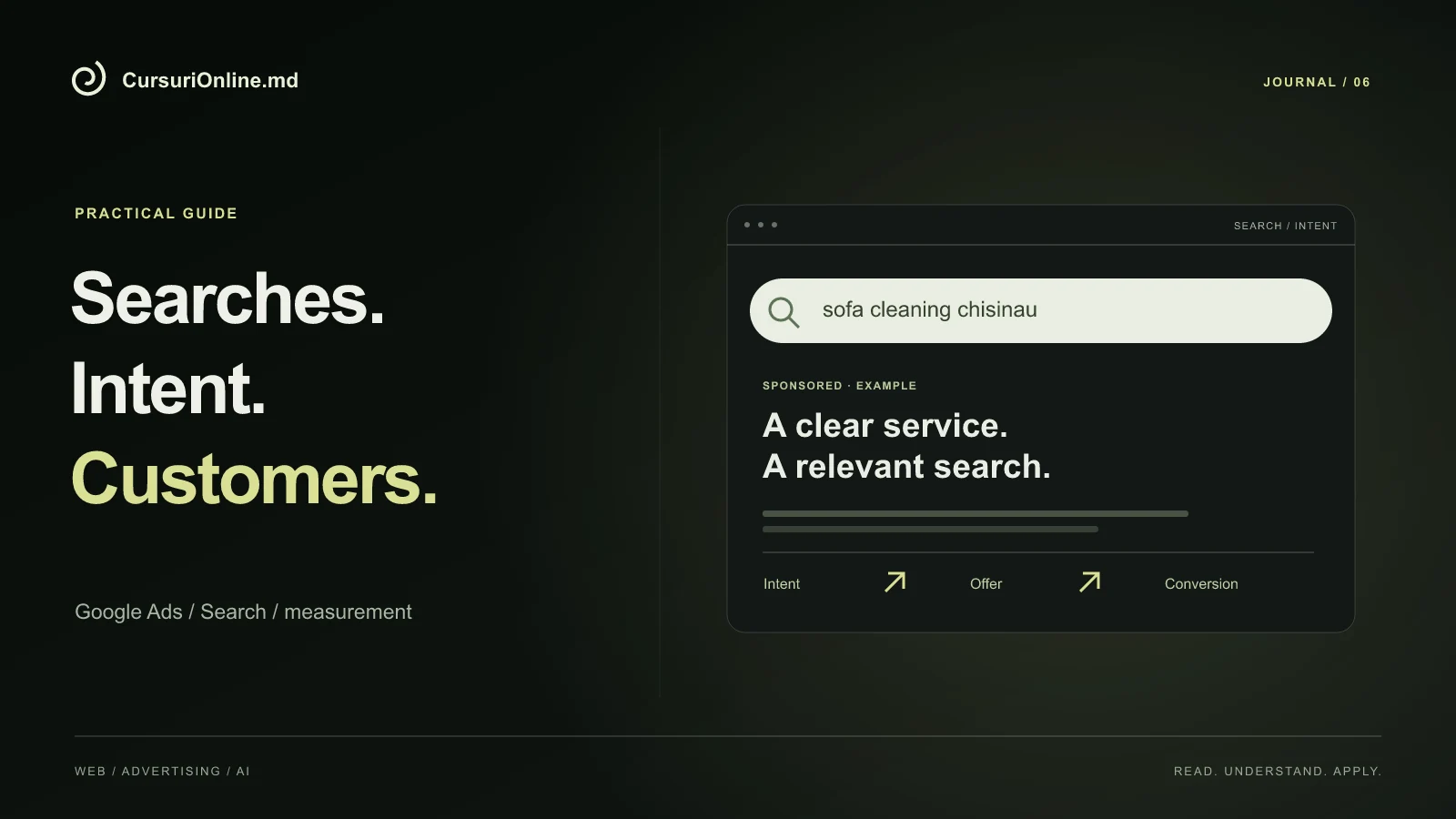
Google Ads is useful when you can link a search to a relevant offer and a clear next step. A person seeking a service expresses an intention, but the intentions are not identical. Someone can compare prices, look for instructions, or be prepared to contact a supplier. A well thought out campaign starts with this difference.
In this guide we follow a Search campaign for a hypothetical furniture cleaning company in Chisinau. The example allows us to discuss structure, keywords, ads, pages, and measurement. It's a learning curve for Google Ads direction, not a recipe that promises a certain cost per customer or permanent position in search results.
Read the intent behind the search phrase
"Couch cleaning at home" can mean that the person wants to clean themselves or that they want a home service. "Sofa cleaning company Chisinau" expresses more clearly the commercial interest. Before building your keyword list, group the phrases by the question they suggest and the offer you can offer.
Don't treat any search volume as a suitable opportunity. If the company does not sell cleaning equipment, interest in the equipment is not the same as interest in the service. If they do not serve in a locality, that request may be inappropriate even if the term includes the name of the activity.
Write a short list of client situations: a stained couch, preparing a home for rent, or regular office maintenance. Each situation may require a different explanation and a different page. This analysis is more useful than mechanically combining the service with all available localities.
Link the campaign structure to the actual offer
Organize the campaign so that the ad and the destination can respond coherently to the search. Couch cleaning and commercial cleaning may have different processes, even if they are offered by the same company. Separating them makes sense when it allows for relevant posts, budgets or pages, not just to create more groups.
A highly fragmented structure can become difficult to manage. If every expression gets a group for no clear reason, changes and analysis become complicated. In Official Account Structure Guidelines, Google emphasizes goals and relevance between search, ad, and page. The concrete application depends on the data and the purpose of the campaign.
For the first exercise, choose a single service and a clear area. Prepare the offer, page and conversion before adding other services. You will be able to understand more easily if the problem occurs when choosing searches, in a message or after entering the website.
Understand match types and check terms
Google Ads uses broad, phrase and exact matching. The "exact" name should not be interpreted as a guarantee that the ad appears only for an identical sequence of characters. Matching takes into account meaning and relationship to intent, according to keyword matching documentation.
The keyword you set and the term the user searches for are different things. That's why analyzing search terms is a work activity, not just a check done at launch. Look for phrases that indicate other services, other products, or an informational need that your page doesn't address.
Use exclusions carefully. A negative word chosen too generally can also block useful requests. Note the reason for each exclusion and check if it applies to the whole campaign or just part of it. The goal is not to eliminate all variation, but to reduce situations where supply and demand do not match.
Write ads that keep the conversation going
A good ad says what you offer, where you work and what the person can do next. For the cleaning company, a message about taking requests for sofas at home is more accurate than a general promise of "best service". Add differences you can support, not superlatives without evidence.
Prepare titles and descriptions that can form coherent combinations. If a critical piece of information appears in a single snippet, check how the ad is displayed and the options available for control. Don't assume that the user will always see all the sentences in the order you wrote them.
The landing page must acknowledge the message. If you list an estimate after the photos, explain how the images are sent and when the discussion begins. If the price depends on the material and size, do not hide this condition. Consistency reduces the gap between the expectation created by the ad and the actual bidding process.
The landing page must be phone ready
A person coming from search does not have to explore the entire website. She wants the relevant answer: what you clean, in which area, how to estimate the price and how to submit a request. Organize this information so that it is easy to find on a small screen without covering the content with banners or windows.
Use real evidence and useful explanations. Photos of the process, types of materials and questions about furniture drying can help decide if they are right for the service being offered. It does not promise to remove every stain when the result depends on the material and the condition of the item.
Test call and WhatsApp buttons, form and confirmation message. A campaign can send relevant visitors to a page with a technical problem. Before you change your keywords, check that your destination is working. Website guide and landing page explains the preparation of this route.
Define conversions before optimization
A conversion must represent an important action and be counted in an understandable way. Submitting a completed form is different from opening the form. A click on the phone shows the intention to call, but does not automatically confirm a conversation or an order. Keep names that reflect these differences.
Google distinguishes conversion actions used for bidding from those tracked for observation. The Official Measurement Guide explains the sources and their configuration. First, determine which event is relevant to the business decision and check that it fires only once in the correct scenario.
If you're importing events from Analytics and also using a separate implementation, check that you're not reporting the same action twice as the primary result. In the case of a service firm, it also keeps a register of requests taken. The advertising platform does not automatically know all the stages of the conversation that take place later in the team.
Sets the budget against a test limit
In the beginning, you need a clear financial limit and a learning goal. There is no universal cost per click or customer for all businesses in Moldova. Competition, area, offer and destination influence the result. A budget estimate should be discussed for the specific project and not confused with a guarantee.
A hypothetical example: €150 spent, 15 requests registered and five orders confirmed. The cost per request would be €10 and the advertising cost per order would be €30. Profitability cannot be deduced from these two figures alone; you need to know the value of the orders and the actual costs of the service.
The bidding strategy is chosen in the context of the objective and data quality. If the event miscounts a simple visit as a request, the automation will use an inappropriate signal. The correctness of the measurement should be verified before drawing conclusions about the effectiveness of an automated strategy.
Organize optimization as an investigation
After launch, start with concrete questions. What searches did you pay for? What messages were displayed? Did the page work? What requests have been taken? Only after this check does it decide whether to change an ad, exclude a search or adjust the offer. Changing all elements simultaneously makes interpretation difficult.
| Observation | Useful check |
|---|---|
| Clicks outside the service area | Geographical settings and actual terms |
| Form started but not submitted | Fields, errors and mobile operation |
| Many requests for another service | The message of the ad and the meaning of the searches |
| Good report, few orders | Qualifying and processing requests |
Keep a log of changes. Write the hypothesis and the effect you expect, then come back when there is enough data to evaluate. If a single customer radically changes the ratio, the volume is still small and the conclusion must be formulated with this limit.
Google Ads and SEO have different roles
Paid advertising and organic visibility can link to the same pages, but they are not the same mechanism. Paying for a campaign does not automatically buy an organic position. At the same time, a well-structured and relevant page is useful to the visitor regardless of the channel through which he arrived.
You can use the questions in the requests to improve the content of the website. If people keep asking about drying time, write a real explanation and check with the team. This helps the offer and reduces confusion without turning every query into a repetitive page created just for a search phrase.
Also compare the Meta Ads role. A visual demonstration can make a service recognizable before the person looks for it, and Google Ads can meet an already expressed need. The choice of channel is based on the offer, resources and customer journey, not on the idea that one is always superior.
Exercise: Design a verifiable campaign
Choose a service, a locality and a final action. Prepare a coherent group of searches, some reasoned exclusions, ad variations and a landing page. Define exactly the conversion and describe how you verify that it has occurred. You can build this plan before you enable ad spend.
Simulate three visitors: one suitable, one looking for free instructions, and one outside the workspace. See if the structure differentiates them and if the offer is understood. Then set the limit of the test and the register in which you will track the actual requests.
The Google Ads course curriculum develops this way of working, and the 1 to 1 mentoring can adapt the exercise to an account or your own project. The desired outcome is the ability to link a search to an offer, measure correctly and make an explainable decision after the test.