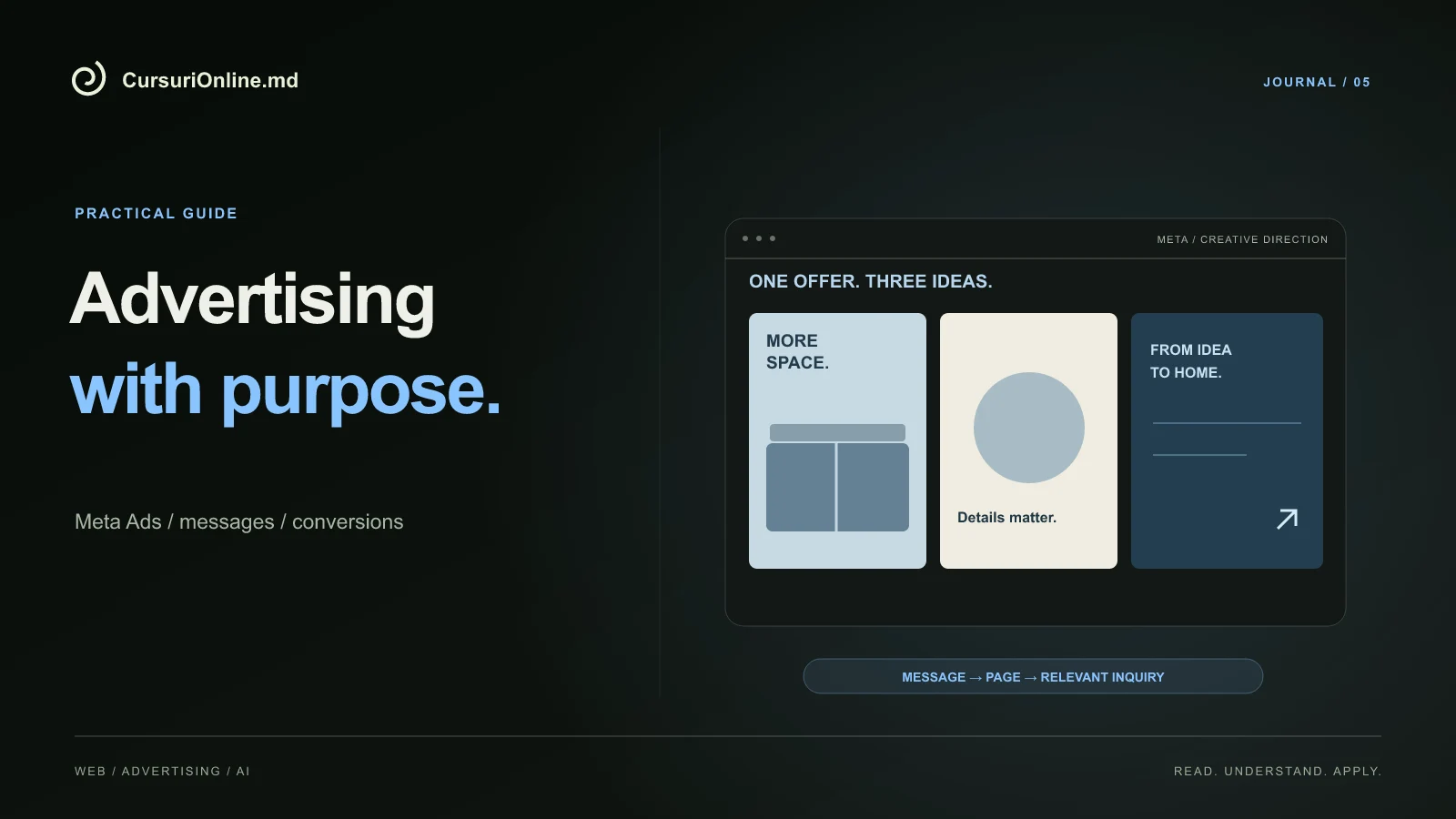
An ad on Facebook or Instagram does not work alone. It is the first part of a conversation that continues on the landing page, form, WhatsApp and business response. When these stages don't match, you can get attention without relevant requests or requests that no one is getting right.
This guide explains the thinking behind a Meta Ads campaign: bid, creative, audience, measurement and post-launch decisions. Let's use a hypothetical example of a furniture shop that wants requests for custom kitchens in the area where it can work. The goal is to learn how to build and evaluate a test, not copy the settings of an account from another industry.
Start with an offer you can support
Before the campaign, describe what the potential customer gets and what they need to do. For the workshop, the offer can be an initial discussion about the project, followed by an estimate after the dimensions and materials are clarified. If the price depends on this information, the advertisement should not suggest a universal final cost.
Formulate useful boundaries: work area, supported project types, and team availability. These details do not automatically reduce the quality of the ad; they can help stop the wrong people from submitting an inquiry. A campaign with fewer messages, but easier to pick up, can be more relevant to the business than one with high volume and confusion.
Check the proof you can show. Own photos, process explanation and real examples provide material for advertising. Don't make up reviews, discounts or rushes. If a project is a render, present it as a render. The credibility of the message must continue after the person asks for details.
Define what a useful result means
A like, a visit, a message and a customer are different stages. Before launching, determine what you're looking for in the test. For the workshop, a relevant request may include location, type of work and actual availability for discussion. This definition helps the team classify the messages in the same way.
The objective chosen in the platform must correspond to the action you can measure and take. A visit-oriented campaign should not be evaluated as if it were built for confirmed orders. Also, a setting that pursues a valuable action does not guarantee that all people will become buyers.
Write before the test what a conclusion will mean. For example: we want to know if the message about organizing the space produces discussions about kitchens, not just comments about appearance. This benchmark helps you analyze the content of the requests, instead of choosing the winner based only on the cost of the cheapest click.
Build a short and coherent route
The ad, page and form must talk about the same offer. If the image shows a compact kitchen, the landing page should provide relevant context, not start with a general list of all the company's services. A person who has reacted to a concrete example is looking for the continuation of that example.
For WhatsApp, it prepares an initial message that helps the conversation without pretending that the user has already confirmed something. It only asks for the information necessary for the first step. If you need ten technical details before you respond, an organized form may be more useful than a conversation that starts with a long list of questions.
Test the route as a new visitor on your phone. Does the page load, read the text, and open the correct contact? Is there anyone responding during the campaign period? An omitted operational detail can affect the test more than the difference between two title variants.
Creative materials should explain, not just attract
Prepare some distinct concepts. One can show the final result, another a space organization problem, and the third the work process. Changing the color of a button is not necessarily a new concept. The useful difference is in the idea the person understands and why they would continue.
For a short video, start with the recognizable situation and show a concrete detail. For example, the way a drawer uses a difficult corner. Add readable text and a simple next step. Don't clutter the frame with all the benefits, three logos and multiple competing prompts.
Keep the important area visible in the formats for which you are preparing the material. Check both the image and the text in the previews available in your account. The tools Figma and Canva Pro can help organize variations, but the ad idea remains an editorial and commercial decision.
Choose the audience in relation to the capacity of the business
A local business must take into account the area in which it can perform and the language in which it can carry on the conversation. Don't expand geography just to get bigger numbers. For our workshop, requests from an area where it cannot deliver is not a good result, even if it looks cheap in comparison.
Avoid treating a long list of interests as an accurate description of the buyer. Audience settings are a way to distribute your ad, and your message and offer also help select your responders. Check the options available in your account and document what you used in the test.
Don't split a small budget into too many combinations that won't get enough data for useful interpretation. Start with a limited hypothesis and a number of options that you can pursue. A simple, understood structure is easier to correct than a complex one created just to look like a large account.
Measurement begins with a correct definition of the event
A click on the WhatsApp button indicates the intention to open a conversation. It does not prove that the message was sent, that the person replied, or that they made a purchase. If you call it "customer", the report becomes misleading before the first optimization. Name the events according to what you actually observe.
For website events, the Meta Pixel and, where appropriate, the Conversions API may be part of the implementation. When the same action is transmitted in two ways, double counting must be avoided. The official Meta for WooCommerce integration includes event identifiers for this purpose; the actual implementation depends on the platform used.
Record the test requests separately and check the result in the business system. Do not transmit personal data in addresses or event names. The measurement configuration must be correlated with the privacy options and information provided to the visitor. A nice tracking chart is no substitute for checking the actual sent data.
Read the report along with the actual requests
A useful report combines the results from the platform with the status of requests. You can see which ad brought in visits, but you also need to find out if the messages were relevant. For a service, note how many requests were taken, how many required clarification, and why some could not continue.
| Signal observed | Diagnostic question |
|---|---|
| Many visits, few requests | Are the offer and next step clear on the page? |
| Many ineligible messages | Are geography and conditions sufficiently communicated? |
| Good requests, late reply | Can the takeover process support the campaign? |
| Different conversions between systems | What does each source count and are there duplicates? |
Don't conclude that an ad is weak after a single interaction, and don't consider a random result as the rule. Note the volume of data and the period analyzed. If the information is insufficient, the correct conclusion may be that you need a better defined test, not a radical change of the entire offer.
A test's budget must have a limit and a goal
The right budget depends on the objective, the commercial offer and the ability to take requests. There is no universal amount that guarantees sales in a particular country. Before you spend, determine the limit of the test and what information you want to get. The learning campaign should not be confused with a promise of immediate cost recovery.
An example analysis, with hypothetical values: you spent €100 and received ten requests, but only four meet the set criteria. The cost per inquiry is €10 and the cost per qualified inquiry is €25. None of these values are cost per customer if there is no confirmed sale yet.
This difference changes the decision. Maybe you need a clearer message, a better page, or a faster pickup. Increasing the budget before understanding where relevance is lost can amplify the same problem. First you check the route, then you choose what is worth expanding.
Exercise: prepare a campaign before you spend
Choose an offer and describe the audience, the scope of work and the definition of a relevant request. Create three ad concepts, each with a distinct idea, and a landing page or conversation. Ask someone to explain what's being offered and what the next step is without giving them extra information.
Prepare a table for the results and a checklist: link, display on phone, event, message, and responder. You can practice this structure without immediately publishing a campaign. Launching a paid test comes after checking your account, materials, and budget limit.
In Meta Ads course, this order helps tie settings to a commercial purpose. If you're missing your landing page, start with the website builder guide. For comparison to search intent promotion, continue with Google Ads. The valuable skill is being able to explain why you chose a test and what you learned from it.